
In our everyday lives, we confidently draw a hard line between waking reality and the elusive world of dreams. What we see and feel with our eyes open is “real,” while our midnight adventures are merely hallucinations. But Taoist philosophy takes a radically different perspective, challenging the very foundation of how we perceive reality.
What if this very moment—the screen you are reading, the chair you are sitting on, the emotions you feel—is simply part of a much larger dream?
The Illusion of Joy and Sorrow
In the foundational Taoist text, the Zhuangzi (specifically the chapter “Discussion on Making All Things Equal”), the ancient sage makes a profound observation about human attachment:
“Those who dream of drinking wine may weep when morning comes; those who dream of weeping may go hunting in the morning. While they are dreaming, they do not know they are dreaming… Only after they awake do they know it was a dream.”
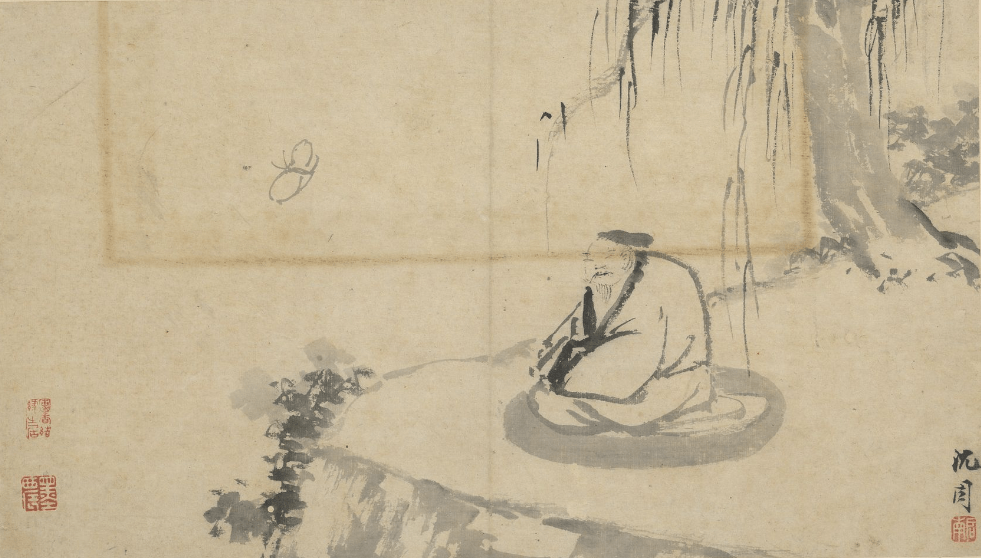
Zhuangzi points out the irony of our emotions. In a dream, a tragedy feels devastating, and a victory feels triumphant. Yet, upon waking, these feelings evaporate into nothingness. Taoism suggests that life itself is a great dream. While we are living it, we are oblivious to our “sleeping” state, becoming deeply attached to fleeting joys and superficial sorrows. We mistakenly believe we are awake and in control, but like a shepherd boy led by the ox, we are often just being pulled along by illusions.
Only through a “Great Awakening” (大觉) can we realize the illusory nature of our daily struggles.
Zhuangzi’s Butterfly Dream: The Ultimate Paradox
Perhaps the most famous illustration of this concept is Zhuangzi’s Butterfly Dream, a cornerstone of Eastern philosophy.
One evening at dusk, Zhuangzi fell asleep and dreamed he was a butterfly. He fluttered his wings, experiencing the pure, unadulterated joy of flight. In that vibrant moment, he was entirely a butterfly; he had completely forgotten he was a man named Zhuangzi.
Suddenly, he awoke and found himself back in his human form. But instead of brushing it off, a profound question struck him: Was he a man who had just dreamed he was a butterfly, or was he a butterfly now dreaming he was a man?
Zhuangzi could be the butterfly, and the butterfly could be Zhuangzi. This story isn’t just a poetic riddle; it’s an invitation to loosen our rigid grip on our identity and the material world, recognizing the fluid, interconnected nature of existence.
The Governor of Nanke: A Lifetime in an Afternoon
Ancient Chinese literature is filled with tales of “suddenly waking from a dream” (恍然如梦). One of the most evocative is the story of Chunyu Fen, which gave rise to the famous idiom “The Nanke Dream” (南柯一梦).
During the Tang Dynasty, a man named Chunyu Fen got blackout drunk celebrating his birthday under a massive ash tree in his courtyard. Falling asleep on the porch, he dreamed he was whisked away in a carriage down a hole at the tree’s roots.
He emerged into a beautiful, sunlit realm called the Great Ash Tree Kingdom. There, he lived a lifetime:
- He married the king’s daughter.
- He was appointed Governor of the Nanke region.
- He ruled justly and successfully for 20 years, amassing wealth, status, five sons, and two daughters. He was at the absolute peak of worldly success.
But the dream turned. A rival kingdom invaded, his army was defeated, and his beloved princess died of an illness. Having lost the king’s favor, a depressed Chunyu resigned and was sent back to his earthly home.
As he exited the tunnel, he jolted awake. He found himself back on his porch. The sun hadn’t even finished setting. His servants were still sweeping the yard, and his friends were just washing up. An entire lifetime of triumph and tragedy had passed in mere minutes. Curious, they dug under the ash tree. They found a massive ant colony with a tunnel leading to a southern branch (Nanke) and a smaller ant hole. His glorious kingdom, his wealth, his 20-year reign—it was all just the bustling of ants in the dirt.
The Call to Awaken
These stories ask us to reflect on our own lives. How much energy do we spend chasing “ant-sized” victories—status, wealth, fleeting romances—believing they are the ultimate reality?
Zhuge Liang, the legendary strategist from the Romance of the Three Kingdoms, perfectly captured this Taoist sentiment in a poem:
“Who is the first to awaken from the great dream? Throughout my life, I alone have known.”
Many people sleepwalk through their entire existence, letting the years slip by in a blur of mundane worries, only realizing the dreamlike nature of it all when the journey is nearing its end. Taoist wisdom encourages us to seek that “Great Awakening” now. By recognizing the transient, dreamlike nature of our physical reality, we can live with more lightness, less anxiety, and a deeper appreciation for the present moment.
Are you awake, or are you still dreaming?
